


Christian Barthomeuf: a Legacy that Has Transformed Québec’s Viticulture Industry and Agricultural Landscape
In a Québec where viticulture was still viewed with considerable scepticism, Christian Barthomeuf boldly persisted to believe it could succeed. In the 1980s, he planted his first vines in the Eastern Townships, developed a cider inspired by our winters, and then patiently transformed an orchard into a living laboratory.
Today, his approach relating to our natural resources has taken root just about everywhere: in our thriving orchards, in the wine-growing landscapes so characteristic of our region, and in the actions of a whole new generation of producers. His contribution isn’t limited to his own products; in fact, he transformed an entire culture.
 vignes et pommiers
 potager du Clos Saragnat
 parcelle de vignes
An Outlandish Idea, Launching a New Agricultural Sector
In 1980, when Christian Barthomeuf founded Domaine Côtes d’Ardoise in Dunham, there was no guarantee that Québec wine had any kind of future. And yet, he believed it would. He planted hybrid grape varieties capable of withstanding our harsh winters. This bold venture launched an entire movement.
However, it was in 1989, with the invention of ice cider through the natural cryoextraction of apples, that this innovative creator paved the way for a new production sector; Indeed, this emblematic product, now governed by a PGI, was adopted by dozens of producers and is now recognized worldwide.
Le Clos Saragnat: A Heartfelt Agro-ecological Project
Beyond his technical innovations, Christian Barthomeuf epitomizes a true vision. When he founded Clos Saragnat in 2002 with his spouse, Louise Dupuis, he wasn’t interested in reproducing traditional methods, but rather in fundamentally altering our connection to the land.
His “fundamental culture” is based on a simple idea: let nature guide the production process. No chemical fertilizers, no artificial irrigation, and no systematic tree pruning. The vines feed on horse dung and the apple trees on chicken droppings. Each plant grows at its own pace, in a living, autonomous ecosystem.
 Christian Barthomeuf
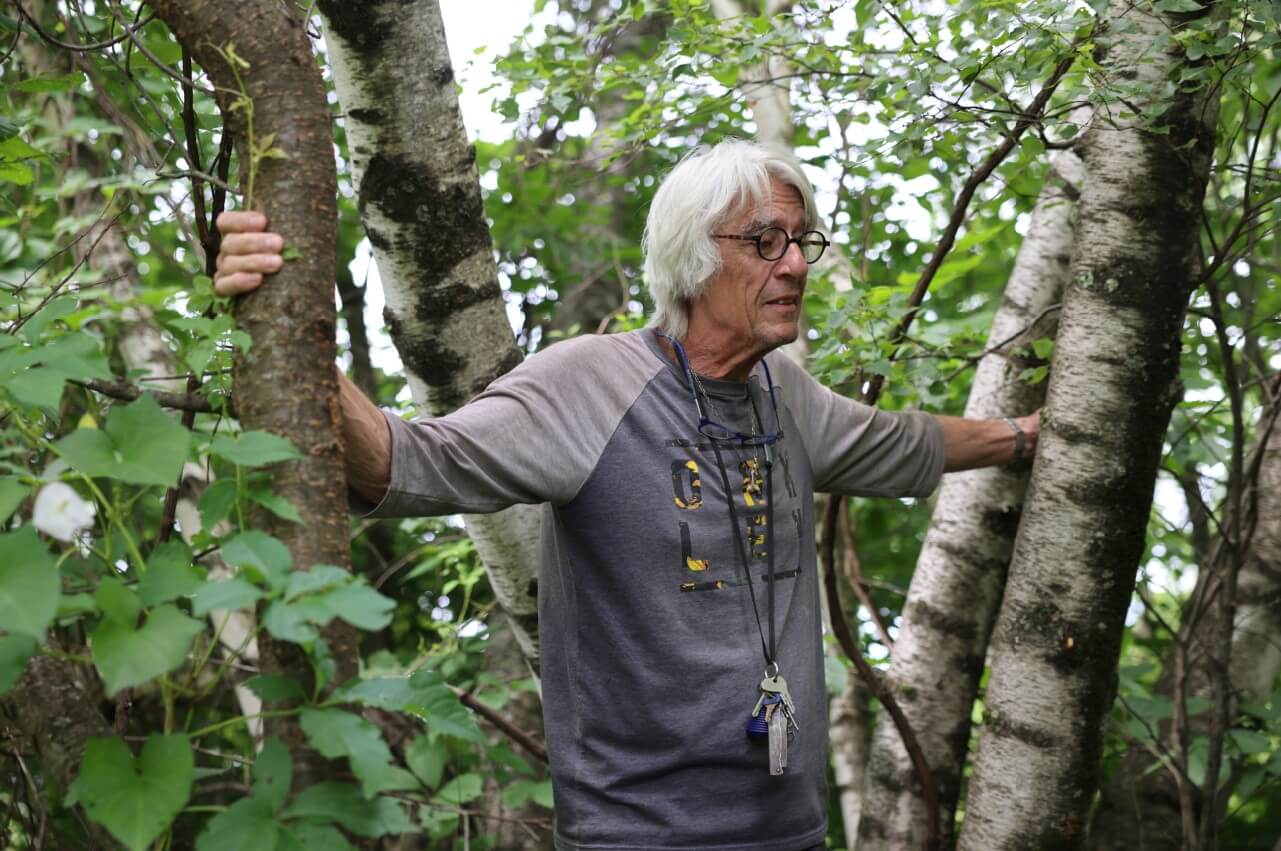 Christian Barthomeuf
 jardins
 pommier
 vignes
It’s a demanding method, requiring time and humility. Sometimes it can take up to fifteen years for an orchard to reach full maturity. But it deeply respects natural cycles.
This groundbreaking approach, at the time, foresaw our major challenges of the present day: soil regeneration, low-impact agriculture and adapting to climate change.
In 2024, after more than twenty years devoted to Clos Saragnat, Christian Barthomeuf and Louise Dupuis closed this chapter of their lives to enjoy a well-deserved retirement. Their approach continues to influence producers and passionate growers who want to farm differently.
An Agricultural Vision That Has Shaped the Region
Le Clos Saragnat isn’t just an organic farm. It’s a research, observation and a knowledge transmission centre. Today, it serves as a study ground relating to scab issues, natural insect management and the climatic resilience of orchards. It attracts young farmers, researchers and the inquisitive, who come to be inspired by a unique and quite radical approach, deeply rooted in the living environment.
Christian Barthomeuf’s impact on the winemaking industry can be seen throughout the regional landscape that surrounds us. The emergence of a Wine Route in the Eastern Townships, officially launched in 2003, is largely owed to the Domaine Côtes d’Ardoise’s founding role. This network, which now includes 25 vineyards, is a testament to the vitality of Québec’s wine industry, a landscape that he very generously helped to define, and which now attracts thousands of visitors every year.
But most importantly, Christian Barthomeuf has changed our relationship with Québec’s terroir. He’s proven that we can produce wines here, within the constraints of our climate, and that quality doesn’t depend on mimicking other regions of the world, but on better understanding our own local environment.
IAn innovator, a visionary, disconcerting for some and rebellious for others, Christian Barthomeuf never minces his words, nor does he leave anyone indifferent. His speech is in tune with his art, without cheating and uncompromising.
Translated from his book Autoportrait d’une paysanne rebelle, p.95


A Widely Recognized and Inspiring Legacy
Christian Barthomeuf has charted a unique course that commands respect and admiration by planting Québec’s first commercial vines, inventing ice cider, and wisely rethinking our relationship with the land.
His contributions earned him the Governor General’s Award for the Culinary Arts in 2010, as well as his appointment to the Order of Canada in 2020.
His legacy to Québec goes far beyond his exceptional products: a transformed territory, deeply rooted know-how, a philosophy of sustainable living, and a new generation of producers who are passionately carrying on his pioneering endeavours.
At a time when the issues of biodiversity, climate and food self-sufficiency are more urgent than ever, his approach resonates with new meaning. What he imagined several decades ago has never been more relevant than today.

If you wish to learn more about the origins of ice cider, don’t miss the article appearing in the Local agri-food industry magazine Origine QC: Interview with Christian Barthomeuf–35 years of ice cider
And for a more in-depth look at Christian Barthomeuf’s life and work, we invite you to purchase his autobiography Autoportrait d’une paysan rebelle
A text by Solène Esnoux